

The monster we export
A sculptural response to the human and ecological costs of e-waste in Ghana
26.03.2026
By Franziska M. Collet
Supervisor: Dr. Susanne B. Unger
Where does my discarded device go once I have replaced it with something newer? The idea that I can simply throw my old electronics away suggests a clean ending: I drop off an old phone, a broken laptop, and a bundle of cables at an official collection point or electronics retailer, and the promise of proper recycling makes the problem disappear from my everyday life. However, electronic waste (discarded electrical and electronic equipment and their components) does not disappear; it is transferred—often through transboundary shipments where the label “used electronics” can disguise waste exports. One destination of these flows is Ghana, which had an eleven times lower per capita generation rate than Germany in 2019, yet carried a highly disproportionate burden of e-waste with more than two thirds of e-waste requiring processing in the country being imported. Once in Ghana, used electronics and e-waste enter a complex informal economy organized through skilled collectors, traders, repairers, and dismantlers, and serves as a necessary form of livelihood within limited formal employment options in the country. A common endpoint for non repairable equipment is manual disassembly and the recovery of valuable fractions such as copper, gold, aluminum, and other metals. One widely used practice is stripping or burning insulated cables, which is highly effective but also releases hazardous pollutants.
These pollutants disperse as smoke and dust, deposit onto soils, enter water bodies and groundwater, and affect ecosystems and food chains downstream, where the release of heavy metals and other toxic substances is described as a threat to aquatic ecosystems and biodiversity. But the consequences are not only environmental: studies report elevated metal concentrations in soils of e-waste burning sites in Accra far above threshold values stated in international guidelines for arable soil. Beyond metals, organic pollutants were detected in ash, soil, and vegetables sampled in e-waste processing areas, linking processing residues to food-related spaces. This exposure has been connected to several health-related issues like cancer, neurodevelopmental deficits, and thyroid hormone disruption. Additionally, biomonitoring evidence indicates that informal recycling work is associated with higher internal burdens of carcinogenic pollutants related to incomplete burning. These findings indicate serious health concerns for workers and nearby residents and are further supported by comparative health assessments. Furthermore, research suggests a gap between exposure and informed risk management: awareness among e-waste workers and other affected groups is described as limited, shaped by insufficient public communication and structural constraints, which in turn influences how risks are perceived and acted upon.
Taken together, this presents e-waste in Ghana as an issue of environmental injustice rather than purely a waste problem. Ghana’s e-waste economy reflects the unequal distribution of environmental harm and protection highlighted in environmental justice frameworks: the consequences of environments contaminated through hazardous recovery practices are disproportionately borne by communities with limited access to protective equipment and few alternative livelihoods, while the benefits of technological progress with constant device upgrades and “clean” disposal remain largely in wealthier consumer societies. While consumption patterns in the Global North are linked to the ever-increasing e-waste volumes, transboundary shipments relocate the associated environmental and human health burdens to the Global South.
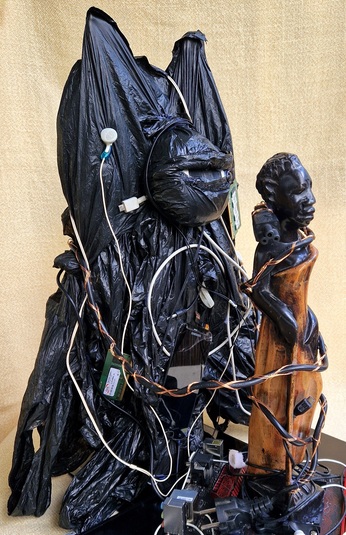
The sculpture “The monster we export” is an attempt to turn the feeling of a lingering physical unease into something a Western audience can encounter rather than only read about: an embodied discomfort that mirrors the hidden costs described above. It is built from two contrasting bodies. At its center stands a traditionally carved wooden figure of a Ghanaian farmer, designed and crafted by a Ghanaian artist and integrated into my sculpture with his knowledge and consent. His figure carries multiple layers of meaning: wood as a natural material contrasting artificial waste, woodcarving as a reference to Ghanaian craft traditions, and the farmer as a symbol of closeness to land and soil—a life that is meant to be grounded, healthy, and self-sustaining. Behind the farmer, out of his sight, lingers an e-waste monster made of discarded electronics and black plastic bags (commonly used in Ghana). The farmer stands on laptop components, representing the contaminated soil.

Formally, the sculpture depicts “entanglement” both physically and metaphorically. Copper wire and cables wrap around the farmer like a constrictor: the coil tightens near the neck as if it is about to cut off breath, while the figure’s posture remains calm and unaware of the danger. The copper wire refers back to the often harmful recovery of valuable metals, linking economic value to health risks, particularly respiratory harms, and livelihood to toxicity.
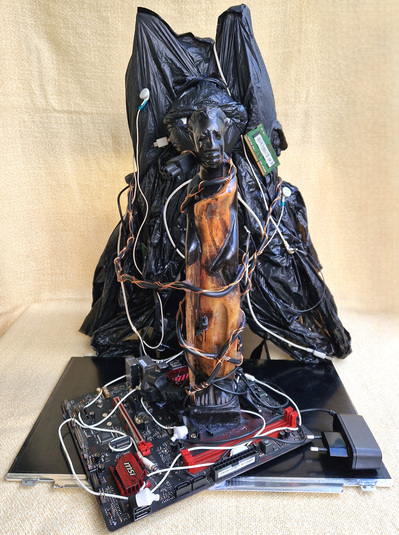
The sculpture challenges the Western idea of clean disposal: it depicts not only “The monster we export” but also a monster we continually feed through constant upgrading and discarding, despite the human and ecological costs it causes. Thus, the sculpture asks a Western audience a simple but uncomfortable question: what is progress worth if it feeds a monster harming people elsewhere?
Limitations and ethical positioning
This project is shaped by my position as a European addressing a Western audience. Any artistic engagement with electronic waste issues in the Global South risks reproducing a colonial gaze and reducing Ghana to a place of suffering. This work does not claim to represent Ghana in a comprehensive way, nor to speak for the experiences of e-waste workers and others affected. Instead, it attempts to portray the relationship between Western consumption and disposal patterns and the harm they externalize elsewhere. My collaboration with a Ghanaian artist on the wooden figure was a deliberate ethical choice, because I wanted the central body of the work to be a self-portrait from within Ghanaian craft traditions rather than a depiction produced solely through my perspective.