Italian-German Fusion at the RCC
08.01.2026
by Maria Elena Köck
In November, we – Ale, Chiara, Henry, Kuldeep, and Maria – had the opportunity to take part in a workshop on Sustainability and Law as part of the RCC Certificate Program. The workshop was organized in cooperation with the Università del Piemonte Orientale, offering us a chance to broaden our horizons in more than one way. Alongside a mock trial—a re-enactment of a real court case—we also attended several lectures by RCC doctoral researchers, exploring the complex interconnections between humans, the environment, and the law.
University on the weekend? Most people would probably imagine more relaxing activities for a snowy November weekend in Munich. But when Susanne Unger told us about this rare course opportunity, we knew we’d have to sacrifice some sleep and other weekend pleasures. After all, how often do you get the chance to step into the roles of judges, prosecutors, and claimants before the European Court of Human Rights—together with Italian students?
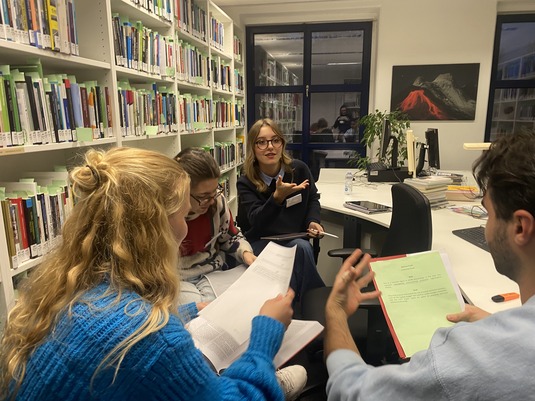
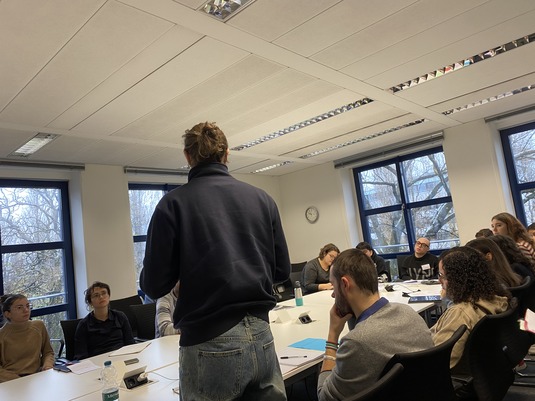
So, on Friday, the first of three workshop days, the five of us joined nearly twenty Italian students and their three accompanying professors in the RCC conference room. After a round of introductions—most Italian students were also meeting each other for the first time, as they came from different stages of their program—we learned that we would be re-enacting an actual European Court of Human Rights case throughout the weekend. It turned out to be a fantastic and fun way to gain insights into the interaction between law and the environment.
The case itself concerned a group of senior Swiss women suing the Swiss government for failing, in their view, to meet its own climate objectives.
For the simulation, we were divided into four groups: prosecutors, claimants, judges, and an advisory panel assisting the judges. Over the weekend, each group prepared for and conducted several court sessions, using character briefs and independent research to develop our roles.
In addition to exploring the field of law and sustainability, we were introduced to a variety of other research areas. Anna Antonova, Davide Orsini, and Judith Bopp shared their current projects with us. Anna presented her Horizon Europe project, which engages coastal communities in integrating coastal characteristics into their lifestyles while promoting a sustainable, inclusive, and resilient development of these regions. Davide offered insights into a large international study examining the socio-ecological and economic implications of nuclear power plant shutdowns in Italy, Germany, Belgium, and the United States. Finally, Judith introduced us to her research on smallholder rural households in Bangladesh and Thailand, focusing on overlapping socio-ecological crises and the adoption of ecological farming practices.
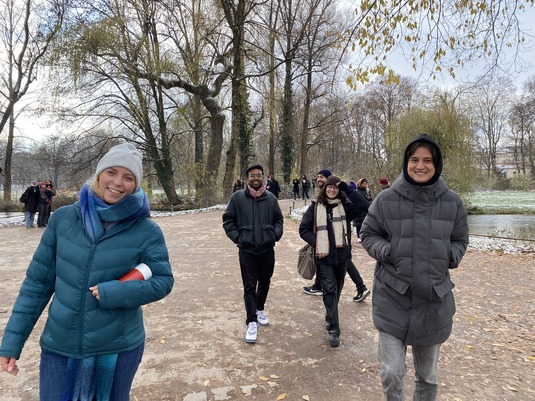
Of course, so much input in one weekend can only be processed with proper breaks – and there were plenty of enjoyable moments for that, too. We shared burgers, visited the Christmas market at the Chinesischer Turm during lunch breaks, and went out for drinks in the evenings. On the very first day, we went to the StuCafé with our Italian peers, and to our delight, the coffee received an enthusiastic “è buono!”.
And indeed, the whole weekend was è buono – truly good. There's only one thing left to say: hopefully, until next time!